Educational familiarization only. This original TechOpsBase resource explains system purpose, architecture and maintenance reasoning. It does not reproduce Airbus pages, diagrams, procedures, limits or controlled maintenance data. Actual aircraft work requires current approved data, correct effectivity, operator procedures, authorization, safety precautions and supervision.
Resource profile
- Aircraft: Airbus A350 family
- ATA chapter: 32 — Landing Gear
- Audience: Students, junior technicians and working professionals
- Level: Intermediate familiarization
- Source basis: Privately supplied legacy manufacturer training and MSG-3 material
- Technical status: Draft pending technical review
Learning objectives
- Describe wheel, tire and brake functions.
- Explain pressure and temperature monitoring.
- Connect wheel speed to anti-skid.
- Recognize stored-energy and heat hazards.
- Apply inspection reasoning.
1. Wheel and tire assemblies
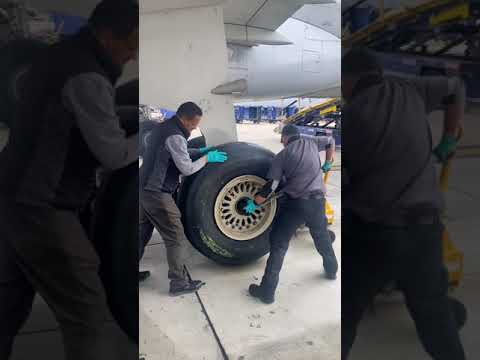
Main wheels carry brake assemblies and transmit braking torque, while nose wheels provide forward support and steering contact. Tires must withstand high load, speed, heat and repeated deformation. Inflation condition, tread, cuts, contamination, fuse-plug status and wheel structural condition affect safe operation.
Tire-pressure indication supports monitoring, but maintenance confirmation still depends on approved servicing and measurement procedures.

2. Brake assemblies
Carbon brake stacks absorb kinetic energy as heat. Wear state, piston operation, hydraulic leakage, heat shields, wheel condition and cooling influence braking performance and turnaround safety.
Brake fans, where installed, improve cooling but add motors, control and thermal-protection interfaces. Their operation does not make a hot-brake area immediately safe.

3. Monitoring chain
Wheel-speed transducers provide information for anti-skid and related functions. Brake-temperature sensors feed the temperature-monitoring chain. Remote brake-control units can interface signals without necessarily performing the higher-level computation.
A displayed value can be affected by the sensor, wiring, remote interface, computer processing or display network. Compare related wheels and independent evidence before condemning a brake.

4. Ground hazards
Inflated tires, hot brakes and brake accumulators store significant energy. Personnel position, cooling time, deflation/servicing rules and exclusion zones must follow approved safety data.
After high-energy braking, rejected takeoff or suspected overheat, the aircraft requires the applicable inspection and cooling criteria—not an informal visual check.
Maintenance boundary
This lesson supports system understanding and maintenance reasoning. It deliberately excludes task steps, numerical limits, servicing quantities, torque values, dispatch decisions and configuration-specific instructions. Before touching the aircraft, confirm the current approved maintenance data, aircraft effectivity, safety procedures, tooling, personnel authorization and restoration requirements.
Review prompts
- What is the commanded function?
- Which computer or control channel accepts the command?
- Which energy source performs the movement or braking action?
- Which mechanical locks, valves or actuators must change state?
- Which sensors confirm that the commanded state was achieved?
- What independent or alternate path remains available?
- What hazards exist if maintenance personnel assume the indication alone proves the system is safe?