Educational familiarization only. This original TechOpsBase resource explains system purpose, architecture and maintenance reasoning. It does not reproduce Airbus pages, diagrams, procedures, limits or controlled maintenance data. Actual aircraft work requires current approved data, correct effectivity, operator procedures, authorization, safety precautions and supervision.
Resource profile
- Aircraft: Airbus A350 family
- ATA chapter: 32 — Landing Gear
- Audience: Students, junior technicians and working professionals
- Level: Intermediate familiarization
- Source basis: Privately supplied legacy manufacturer training and MSG-3 material
- Technical status: Draft pending technical review
Learning objectives
- Identify major MLG structural groups.
- Explain shock absorption and load transfer.
- Describe locking and retraction functions.
- Explain bogie pitch-trimmer purpose.
- Recognize inspection and safety priorities.
1. Structural load path
The main landing gear transfers aircraft weight and dynamic landing loads into the wing structure. The shock absorber reduces peak loads by combining compressible gas with controlled hydraulic-fluid displacement. The main fitting, sliding member, torque links, bogie beam, axle and wheel assemblies must maintain alignment while allowing vertical shock-strut movement.
Side stays and lock links establish a stable ground geometry. Their purpose is not only to carry load but also to resist collapse until the commanded unlocking sequence occurs. Wear, freeplay, incorrect rigging, damaged bearings or degraded lock geometry can therefore affect both structural integrity and reliable retraction.

2. Bogie and pitch management
The four-wheel bogie distributes load and lets the wheel pairs follow runway geometry. During retraction and extension, bogie angle must be controlled so the assembly clears bay structure and doors. A hydraulic pitch-trimmer actuator positions the bogie for the appropriate phase.
A bogie-angle or pitch-trimmer problem may appear as a sequencing fault even when the main retraction actuator is serviceable. Troubleshooting must compare actual bogie position, command state, hydraulic availability and related sensing.

3. Retraction, locks and doors
The retraction actuator moves the gear after the locks are released. Uplock and downlock mechanisms secure the gear at the ends of travel. Main doors are hydraulically operated, while other fairing or hinged door elements may follow the leg mechanically.
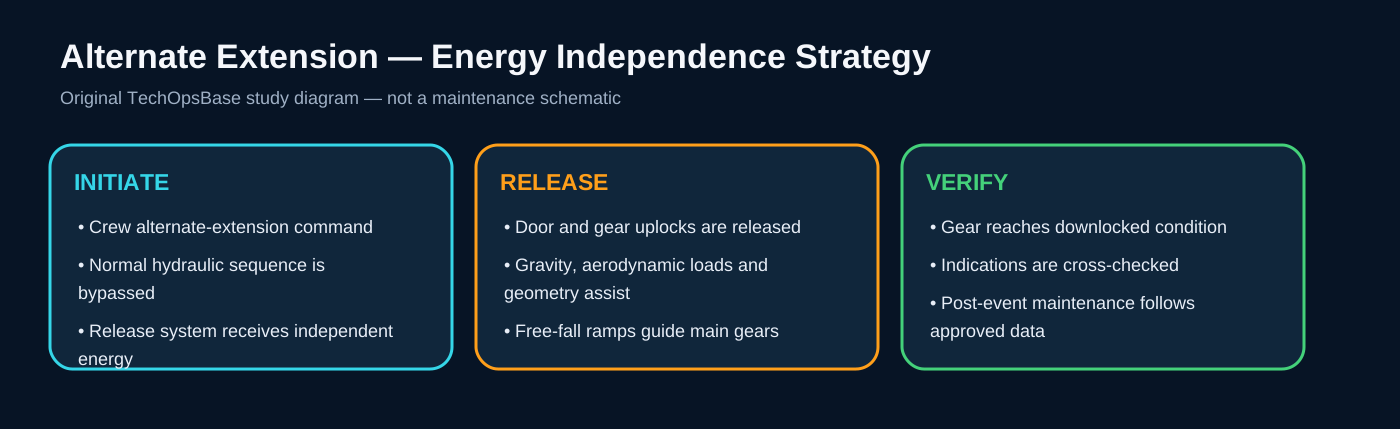
Free-fall ramps and rods help guide the MLG during alternate extension. Obstruction, contamination, deformation or incorrect adjustment along this path can prevent reliable free fall even if the release command works.
4. Maintenance and failure awareness
Inspection priorities include leakage, shock-absorber extension, structural damage, tire and wheel condition, brake condition, lock-link and side-stay wear, door attachment, sensor security and evidence of abnormal loads. Load-exceedance data can guide further inspection but does not replace the approved structural assessment.
Before entering the bay or standing on an approved door surface, install and verify the required safety devices. A system indication cannot confirm that a physical safety pin is correctly installed.

Maintenance boundary
This lesson supports system understanding and maintenance reasoning. It deliberately excludes task steps, numerical limits, servicing quantities, torque values, dispatch decisions and configuration-specific instructions. Before touching the aircraft, confirm the current approved maintenance data, aircraft effectivity, safety procedures, tooling, personnel authorization and restoration requirements.
Review prompts
- What is the commanded function?
- Which computer or control channel accepts the command?
- Which energy source performs the movement or braking action?
- Which mechanical locks, valves or actuators must change state?
- Which sensors confirm that the commanded state was achieved?
- What independent or alternate path remains available?
- What hazards exist if maintenance personnel assume the indication alone proves the system is safe?