Educational familiarization only. This original TechOpsBase resource explains system purpose and relationships. It does not reproduce Airbus pages, diagrams, task instructions or controlled maintenance data. Actual aircraft work requires current approved data, correct effectivity, operator procedures, authorization and supervision.
Learning objectives
- Identify the measured fuel properties.
- Explain why fuel properties affect quantity indication.
- Recognize where measurement enters the FQMS chain.
1. Why fuel properties matter
Fuel quantity is displayed as mass, while tank sensors primarily support volume and level calculation. Converting volume to mass requires reliable fuel density. Capacitance measurement also depends on fuel permittivity, which varies with fuel type and temperature.
2. Measurement during refuel
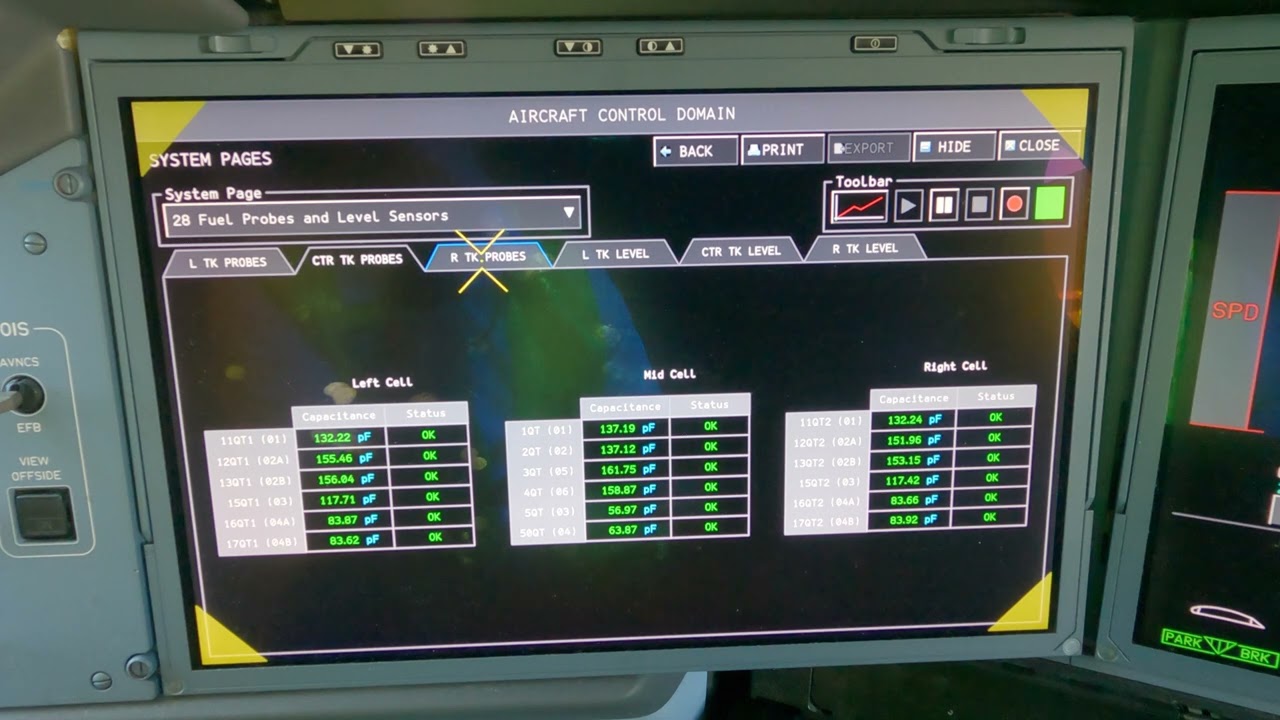
Fuel Properties Measurement Units connected to the refuel gallery characterize uplifted fuel. The primary properties are:
- Density
- Permittivity
- Temperature
Tank temperature probes add local tank information. The FQMS uses these values with level and geometry data to improve quantity computation.
3. Fault effects
Incorrect properties can produce quantity disagreement even when level sensors are healthy. Troubleshooting should compare uplift data, tank temperature, independent quantity indications and fault reports.
4. Maintenance awareness
Fuel contamination, mixed fuel grades, trapped old fuel, temperature stratification or sensor faults can complicate interpretation. Fuel-property measurements support calculation but do not replace approved fuel-quality sampling.
5. Density
Density is mass per unit volume. The same tank volume contains different mass when fuel density changes.
Density is affected by fuel grade and temperature. Warmer fuel generally occupies more volume for the same mass. Quantity calculation therefore needs current or representative density.
6. Permittivity
Capacitance probes respond to the dielectric properties of the material around them. Fuel permittivity varies by composition and temperature.
If the system assumes the wrong permittivity, probe capacitance can be converted into the wrong level or volume. Measuring properties of uplifted fuel improves the calculation.
7. Temperature
Fuel temperature affects:
- Density
- Permittivity
- Viscosity
- Water separation
- Ice risk
- Fuel-system operating limits
Tank temperature can differ from uplift temperature. Large tanks can have temperature gradients and mixed fuel layers.
8. In-line fuel-properties measurement
Fuel-properties units are installed in the refuel flow path. During uplift they measure characteristics of incoming fuel before or while it enters the tanks.
A unit can provide:
- Density-related measurement
- Permittivity-related measurement
- Temperature
- Validity or fault status
The data is passed into the FQMS processing chain.
9. Mixed fuel
When new fuel is loaded onto remaining fuel, the final tank properties are a mixture.
Mixing is not always instantaneous. Temperature and density stratification can exist for a period. Quantity indication can stabilize as fuel mixes and temperatures equalize.
The FQMS uses available data and algorithms, but a post-refuel difference should be considered in the context of mixed fuel rather than treated immediately as a probe failure.
10. Relationship to mass calculation
A simplified reasoning chain is:
- Probe data estimates fuel surface and volume.
- Tank geometry converts level distribution to volume.
- Fuel properties convert volume to mass.
- Temperature correction improves the result.
- Redundant applications validate and display the quantity.
An error at any step can affect displayed mass.
11. Failure patterns
Invalid fuel-properties data
The FQMS may use a fallback value or degraded calculation and issue a maintenance message.
One unit disagrees
Compare with the second measurement path, uplift certificate and tank-temperature data.
Quantity error changes after refuel
Consider the new fuel properties and mixed-fuel condition.
Quantity error persists across fuel loads
Probe, wiring, geometry input or concentrator faults become more likely.
12. Fuel quality versus measured properties
Fuel-properties measurement supports quantity calculation. It does not certify that fuel meets all quality specifications.
Contamination, microbial growth, particulate matter, incorrect additive content or water can require physical sampling and laboratory or approved field checks. A normal density reading does not prove clean fuel.
13. Maintenance interfaces
Properties units interface with:
- Refuel gallery
- FQMS
- Electrical power
- Tank-wall data concentration
- IRP quantity display
- Fuel-quality servicing records
Line installation and sensor calibration can affect both refuel integrity and quantity accuracy.
14. Diagnostic questions
When quantity differs from delivered fuel:
- Was the delivered amount measured by volume or mass?
- What density and temperature were used?
- Was fuel already on board?
- Were different grades mixed?
- Has the aircraft stabilized?
- Do primary and independent indications agree?
- Are fuel-properties units valid?
- Is water or contamination suspected?
These questions keep the investigation from focusing only on tank probes.
15. Measurement validation
Fuel-properties data can be compared with:
- Supplier delivery documentation
- Refuel-equipment density indication
- Expected fuel-grade range
- Tank temperature
- Independent quantity calculation
- Previous uplift history
A difference does not automatically mean the aircraft sensor is wrong. Ground equipment, temperature reference and units must be compared on the same basis.
16. Calibration and configuration
The properties unit, wiring and FQMS software must use the correct calibration and configuration. Replacing a sensor with an incorrect variant can create a consistent quantity bias.
Software configuration and aircraft effectivity are part of the measurement chain.
17. Density-temperature relationship
Fuel expands as it warms. A volume loaded at one temperature represents a different mass than the same volume at another temperature.
The system reports mass so operational fuel planning remains meaningful. Temperature compensation reduces the effect of volume expansion, but sensor and density accuracy still matter.
18. Quantity reconciliation
When reconciling uplift with onboard quantity:
- Establish starting onboard fuel.
- Identify whether delivered fuel is recorded as mass or volume.
- Apply the correct density and unit conversion.
- Consider fuel used by APU or engines during servicing.
- Consider gallery and line fuel.
- Allow for sensor and ground-equipment tolerance.
- Check for actual leakage or incorrect tank distribution.
A simple subtraction can be misleading if the measurements use different units or temperatures.
19. Water and density
Free water is much denser than jet fuel. A properties unit measuring the bulk refuel flow may not identify a localized tank water puddle.
Fuel-properties measurement and water drainage therefore address different problems.
Key takeaways
- Mass indication requires more than level measurement.
- Density, permittivity and temperature are linked to quantity accuracy.
- Fuel-property data enters the tank-wall/FQMS processing chain.
- Fuel quality and fuel quantity are related but separate maintenance questions.
Approved-data boundary
This resource is a study aid. It must not be used to determine maintenance steps, limits, dispatch status, component removal criteria or aircraft configuration. Use the current applicable AMM, TSM/FIM, WDM, IPC, CMM, ALS/CDCCL data, operator procedures and task cards for real work.