Educational familiarization only. This original TechOpsBase resource explains system purpose and relationships. It does not reproduce Airbus pages, diagrams, task instructions or controlled maintenance data. Actual aircraft work requires current approved data, correct effectivity, operator procedures, authorization and supervision.
Learning objectives
- Explain why selected fuel lines are enclosed by shrouds.
- Trace leakage from a shroud to an external drain mast.
- Distinguish containment from leak prevention.
1. Purpose
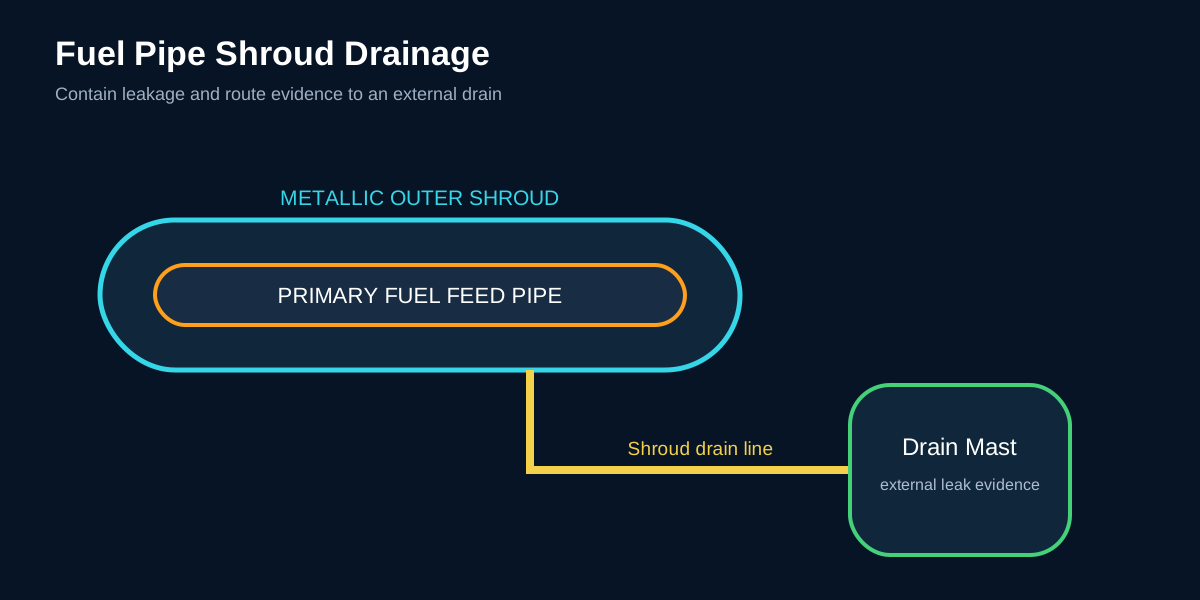
Selected APU and engine fuel-feed lines pass through or near areas where uncontrolled fuel leakage could create a serious hazard. A metallic outer shroud surrounds the primary fuel pipe and provides a controlled secondary containment path.
The shroud does not make a leaking inner pipe acceptable. Its job is to prevent fuel from freely entering the fuselage or pylon area and to route evidence of leakage to a visible external location.
2. Drain route
A drain line connects the low area of the shroud to a drain mast. APU-line drainage is routed toward the lower aft fuselage, while engine-feed shroud drainage is routed toward the applicable engine/pylon drain outlet.
Flexible joints accommodate normal aircraft movement and help preserve containment under structural movement. The pipe and shroud use fire-resistant metallic construction in the protected route.
3. What drain evidence means
Fuel at a drain mast can indicate leakage from the enclosed feed line or an associated connection. The observation should start an approved investigation; it is not enough to wipe the outlet and monitor informally.
Troubleshooting should consider:
- Inner fuel-pipe leakage
- Coupling or seal condition
- Shroud continuity
- Drain-line blockage or damage
- Incorrect routing or installation
- Evidence of fuel in adjacent structure
4. Maintenance awareness
Do not block, cap or reroute a drain path to stop visible leakage. Doing so removes the warning and containment function while leaving the source defect active.
6. Why selected fuel pipes are shrouded
A shroud is a secondary containment tube around a primary fuel pipe. It is used where a leak from the primary pipe could otherwise enter a vulnerable aircraft area.
The APU feed line passes through fuselage and tail-cone regions before reaching the APU. Engine-feed pipes pass through wing and pylon areas. A secondary shroud provides a controlled annular space around these lines. If the primary pipe leaks, the fuel is retained and routed toward an external drain instead of spreading freely through structure.
The shroud does not make a primary pipe leak acceptable. It limits the immediate consequence and creates a visible path for detection.
7. Drainage architecture
The containment path can be studied as:
Primary pipe -> shroud annulus -> drain line -> external drain mast
The APU feed-pipe shroud drains toward a dedicated mast. Engine-feed shroud areas drain through designated engine or pylon drain outlets. The external outlet is positioned so fuel evidence can be observed and discharged away from sensitive structure.
The path depends on gravity and clear tubing. Low points, bends, couplings and outlet openings must remain correctly routed.
8. Integrity versus blockage
Two different failures matter.
Loss of shroud integrity
A crack, disconnected coupling or damaged shroud can allow leaked fuel to escape before reaching the intended drain. The containment function is reduced.
Drain blockage
The shroud can remain physically intact while the drain path is blocked. A primary pipe leak can then fill the annular space. There may be no cockpit indication of the blocked drain itself.
These failures illustrate why separate checks can be required for shroud integrity and drain-mast freedom.
9. Relationship to APU line protection
The APU fuel line includes isolation and thermal-relief functions. If trapped fuel expands after shutdown, relief paths limit pressure. If a line failure still produces leakage, the shroud and drain provide another protection layer.
Line-break detection, valve closure, pump shutdown, thermal relief and drainage are separate defenses. A technician should not assume one protection makes the others unnecessary.
10. External leak evidence
Fuel at a drain mast can indicate a primary pipe or component leak upstream. The outlet location helps narrow the system area but does not by itself identify the failed component.
Evidence assessment includes:
- Whether the fluid is fuel or another aircraft fluid
- Whether the outlet is the correct dedicated drain
- Whether the leak is continuous, intermittent or configuration-dependent
- Whether pump pressure or APU operation changes the rate
- Whether the shroud path is clear
- Whether fuel may have migrated from an adjacent source
Current fault-isolation data controls the actual diagnostic process.
11. Hidden-failure logic
A blocked drain or damaged shroud may be hidden during normal operation because no leak exists at that time. The safety concern appears when the hidden condition combines with a primary fuel-pipe leak.
Maintenance-program analysis therefore considers the combined event, not only the single failure. This is a useful MSG-3 lesson: tasks often protect against combinations of one hidden and one active failure.
12. Maintenance awareness
Shroud work can involve:
- Pipe support and alignment
- Couplings and seals
- Drain-line slope
- Clearance from structure
- Fire-zone or ignition-source separation
- External outlet condition
- Leak checks
- Restoration after nearby maintenance
Do not use compressed air, pressure or cleaning methods unless the approved task permits them. The educational objective is to understand the path; the actual test method is controlled data.
13. Troubleshooting mental model
When drain evidence is present, map the system in reverse:
- Identify the drain outlet.
- Identify the shroud or compartment it serves.
- Identify the pressurized fuel lines inside that containment.
- Determine which operating mode could pressurize them.
- Check whether isolation and indication agree.
- Use the approved leak-isolation task.
When no drain evidence exists but a smell or unexplained fuel loss is reported, do not assume the shroud is dry. A blocked or disconnected drain can hide leakage.
Key takeaways
- The shroud contains and directs leakage; it does not replace pipe integrity.
- Drain masts make otherwise hidden leakage observable.
- A clear drain path is a safety feature.
- Leak investigation and rectification require current approved data.
Approved-data boundary
This resource is a study aid. It must not be used to determine maintenance steps, limits, dispatch status, component removal criteria or aircraft configuration. Use the current applicable AMM, TSM/FIM, WDM, IPC, CMM, ALS/CDCCL data, operator procedures and task cards for real work.