Educational familiarization only. This original TechOpsBase resource explains system purpose, architecture and maintenance reasoning. It does not reproduce Airbus pages, diagrams, task instructions or controlled maintenance data. Actual aircraft work requires current approved data, correct effectivity, operator procedures, authorization and supervision.
Resource profile
- Aircraft: Airbus A350 family
- ATA chapter: 27 - Flight Controls
- Audience: Students, junior technicians and working professionals
- Level: Intermediate familiarization
- Source basis: Privately supplied 2013-2014 manufacturer training and MSG-3 material
- Technical status: Draft pending technical review
Learning objectives
- Trace a roll command to aileron and spoiler response.
- Explain spoiler multifunction use.
- Distinguish hydraulic, electrical and anti-extension modes.
- Recognize evident and hidden actuator degradations.
1. Roll-command processing
A lateral side-stick or autopilot order is processed by the lateral control laws. The computers combine desired roll response with yaw coordination, airspeed, configuration and load-management functions. The resulting commands are distributed across ailerons and spoilers according to availability and flight condition.

Maintenance questions to ask
- What is the commanded condition and what independent evidence confirms it?
- Which computer, sensor, hydraulic and electrical channels are required in this configuration?
- Is the failure crew-evident, maintenance-evident or hidden until a dedicated test?
- Which current approved document and effectivity control the next action?
2. Ailerons
Inboard and outboard ailerons provide primary roll authority and can support high-lift or drag optimization. Their actuators receive electrical commands from flight-control computers and hydraulic or local electro-hydraulic power. Position transducers close the servo loop. Monitoring compares command, actuator state and surface response.

Maintenance questions to ask
- What is the commanded condition and what independent evidence confirms it?
- Which computer, sensor, hydraulic and electrical channels are required in this configuration?
- Is the failure crew-evident, maintenance-evident or hidden until a dedicated test?
- Which current approved document and effectivity control the next action?
3. Spoilers as multifunction surfaces
Spoilers assist roll through differential deployment. Symmetric deployment provides speed-brake action. Ground-spoiler deployment rapidly removes wing lift after landing and improves wheel-braking effectiveness. Spoilers can also support load alleviation and follow flap movement to maintain aerodynamic gap requirements.
Maintenance questions to ask
- What is the commanded condition and what independent evidence confirms it?
- Which computer, sensor, hydraulic and electrical channels are required in this configuration?
- Is the failure crew-evident, maintenance-evident or hidden until a dedicated test?
- Which current approved document and effectivity control the next action?
4. EBHA modes
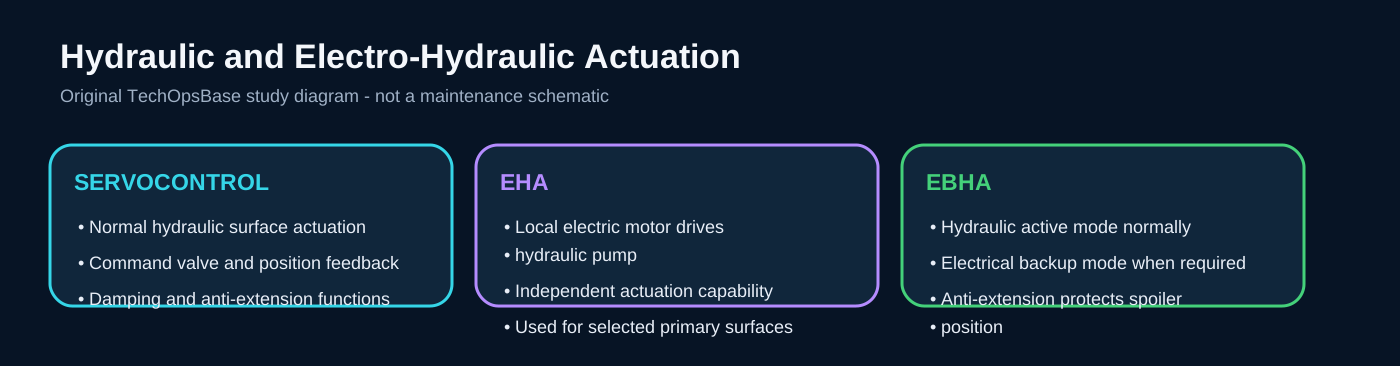
Selected spoilers use electrical backup hydraulic actuators. In normal hydraulic active mode, aircraft hydraulic pressure moves the surface. Electrical active mode can provide local backup. Anti-extension mode prevents an unpowered surface from being lifted by aerodynamic load. A failure to select a backup mode can be hidden while normal hydraulics remain available, which explains the importance of ground monitoring.

Maintenance questions to ask
- What is the commanded condition and what independent evidence confirms it?
- Which computer, sensor, hydraulic and electrical channels are required in this configuration?
- Is the failure crew-evident, maintenance-evident or hidden until a dedicated test?
- Which current approved document and effectivity control the next action?
5. Speed brake and ground spoiler logic
Speed-brake commands are limited or retracted when aircraft conditions make deployment undesirable. Ground-spoiler logic requires a valid landing state and uses multiple aircraft inputs. A malfunction may affect stopping performance even when roll control remains available.
Maintenance questions to ask
- What is the commanded condition and what independent evidence confirms it?
- Which computer, sensor, hydraulic and electrical channels are required in this configuration?
- Is the failure crew-evident, maintenance-evident or hidden until a dedicated test?
- Which current approved document and effectivity control the next action?
6. Maintenance reasoning
Determine whether the problem concerns one actuator, one surface, one function or the common lateral law. Check hydraulic supply, actuator mode, position feedback, wiring and computer commands. Inspect freeplay, leakage, attachment and surface condition using approved limits. Hidden backup-mode degradation requires the prescribed test; normal surface movement alone does not prove the backup function.
Maintenance questions to ask
- What is the commanded condition and what independent evidence confirms it?
- Which computer, sensor, hydraulic and electrical channels are required in this configuration?
- Is the failure crew-evident, maintenance-evident or hidden until a dedicated test?
- Which current approved document and effectivity control the next action?
Integrated review
Use the input ? computation ? power ? actuation ? feedback ? indication model. A correct diagnosis must explain both the physical symptom and every associated message. Avoid replacing a computer merely because it generated the warning; it may be reporting loss of an external input, power source or actuator response.
Key takeaways
- Trace a roll command to aileron and spoiler response.
- Explain spoiler multifunction use.
- Distinguish hydraulic, electrical and anti-extension modes.
- Recognize evident and hidden actuator degradations.
Current approved maintenance data always controls aircraft work.