Educational familiarization only. This is original TechOpsBase learning content. It does not reproduce Airbus pages, diagrams, procedures, maintenance-task instructions, numerical limits or controlled data. Actual aircraft work requires current approved data, correct aircraft effectivity, operator procedures, authorization, safety precautions and supervision.
Resource profile
- Aircraft: Airbus A350 family
- ATA chapter: 26 - Fire Protection
- Audience: Aviation enthusiasts, students, junior technicians and experienced maintainers
- Level: Intermediate system familiarization with maintenance reasoning
- Source basis: Privately supplied legacy manufacturer training and MSG-3 analysis
- Publication status: Draft pending technical review
Learning objectives
- Establish a safe ATA 26 troubleshooting boundary.
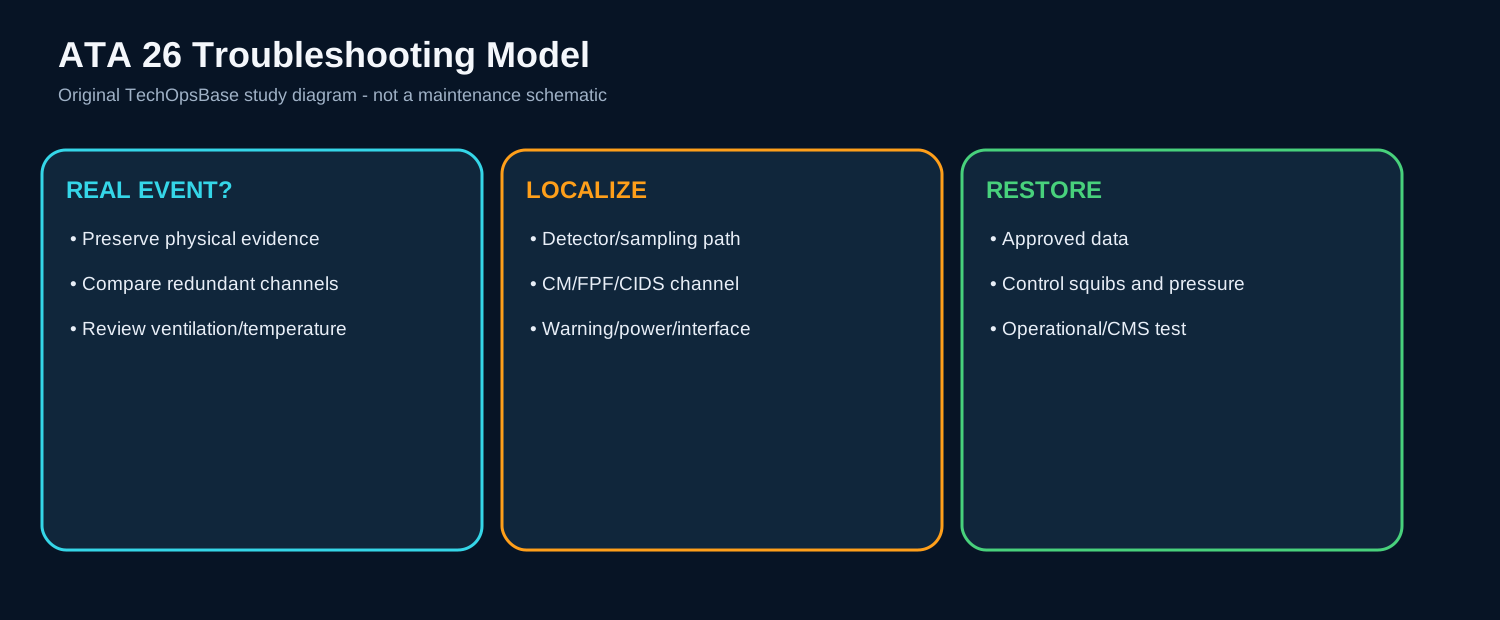
- Separate real fire/smoke evidence from sensor or interface faults.
- Use redundancy patterns to localize failures.
- Work through integrated engine, cargo, cabin and avionics scenarios.
- Preserve evidence before resets and component replacement.
1. Safety and evidence before diagnosis
ATA 26 troubleshooting can expose personnel to pressurized agent bottles, energetic cartridges, squibs, hot-battery circuits, hot engine/APU structure, rotating ventilation equipment and contaminated smoke paths. A fault that appears electrical can still involve a charged bottle or an armed firing circuit.
Identify every normal, emergency and hot-battery power source. Apply approved squib and cartridge safety devices. Prevent unintended agent discharge and confirm protected compartments are safe before access.
Record warning text, protected zone, time, flight phase, detector-loop status, bottle indications, ventilation state and related faults before resetting or clearing history.
2. Engine warning that clears
Treat the warning as credible. Determine whether both loops agreed, one loop was already failed, or a channel disagreement occurred. Inspect the identified engine zone for hot-air leakage, fluid residue, electrical damage, scorched insulation and detector contact with hot structure.
Review whether fire control was selected and which isolation functions operated. A cleared warning does not prove the initiating leak stopped permanently.
Only after physical and system evidence is collected should detector, wiring, conversion channel and FPF faults be isolated.

3. Cargo smoke and extinguishing scenarios
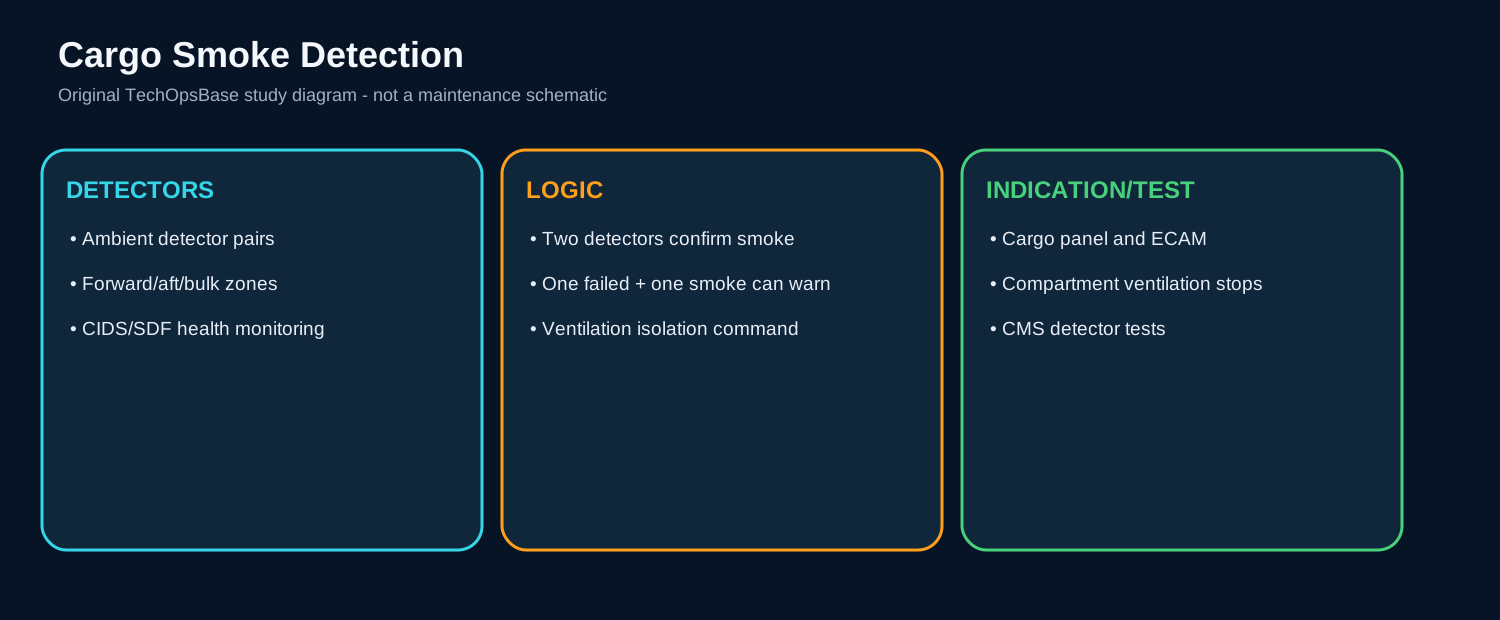
Review detector-pair status and whether ventilation isolated automatically. Inspect cargo contents, liner gaps, electrical equipment, contamination and ventilation ducts. Smoke can dissipate before access.
If the cargo bottle indication is abnormal, separate command from discharge. Check FEDC command, diverter selection, squib continuity and pressure or flow confirmation.
The flow-metered bottle responds more slowly than the rapid bottle. Compare indication timing with approved behavior rather than assuming immediate failure.

4. APU/MLG, cabin and avionics scenarios
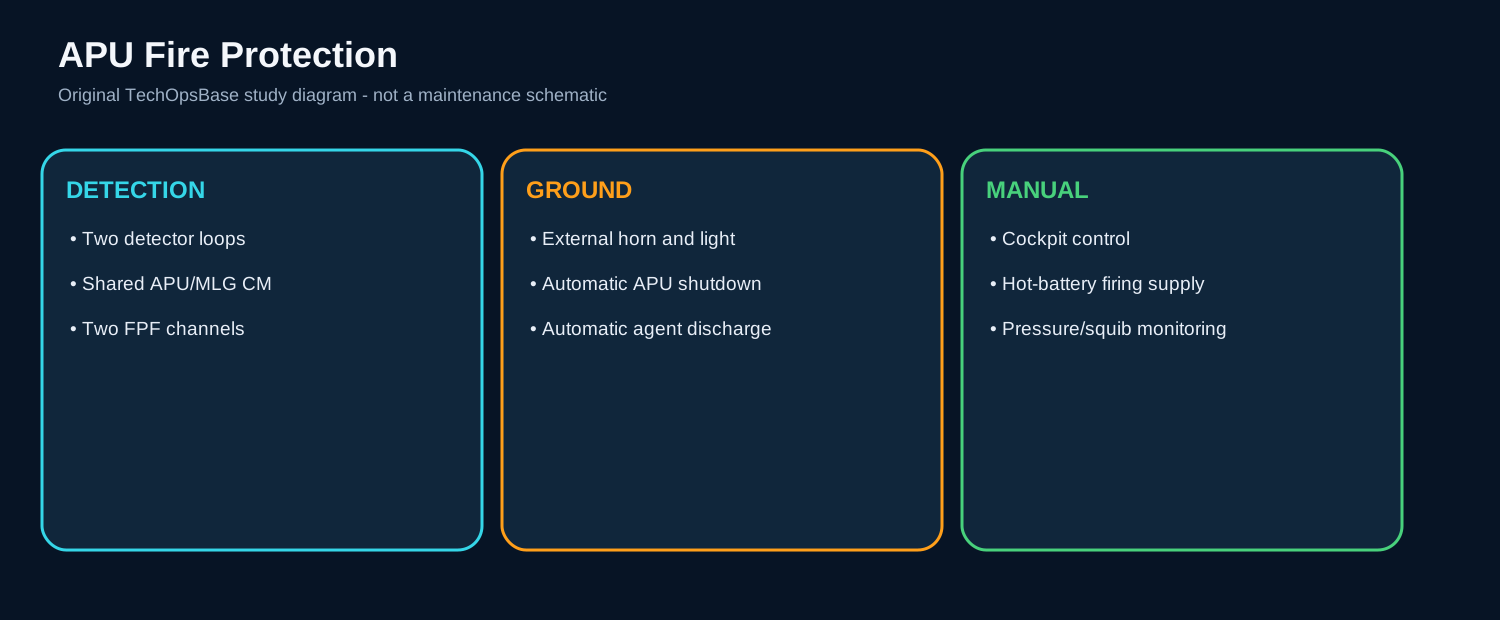
Because APU and MLG-bay detection share a conversion module, simultaneous channel faults point toward shared conversion, power, data or wiring interfaces.
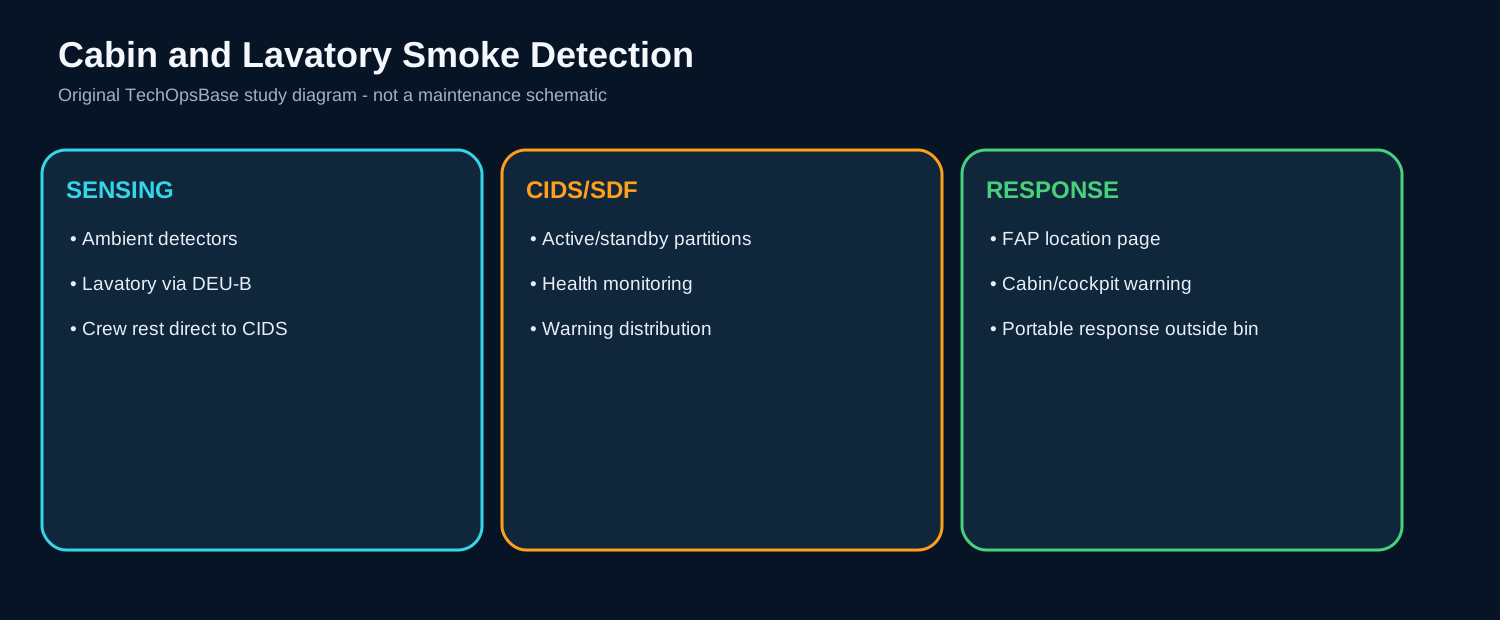
For repeated lavatory smoke warnings, review cleaning activity, steam, detector contamination, DEU-B status and whether the waste-bin bottle discharged.
For avionics smoke with a ventilation fault, determine whether smoke caused protective fan shutdown or cooling loss caused equipment overheating. Event order matters.


5. Release-to-service discipline
Complete approved operational or CMS tests for the affected function and redundancy. Verify detector-loop health, bottle pressure, squib continuity, panel indications, ventilation commands and fault-record closure as applicable.
Restore every connector, clamp, detector support, sampling tube, duct, bottle restraint, safety device and access panel. A passed electronic test cannot compensate for incomplete physical restoration.
Document the initiating cause, not merely the replaced component.

Maintenance boundary
This resource teaches system architecture and fault reasoning. It deliberately excludes cartridge handling, squib isolation steps, bottle removal procedures, discharge tests, detector acceptance limits, resistance values, agent quantities, warning-reset procedures and dispatch decisions. Fire bottles, cartridges, squibs, hot-battery circuits and pressurized agent are hazardous. Use the current approved AMM, TSM, wiring data, safety procedures and aircraft effectivity before performing aircraft work.
Review prompts
- Which zone is being protected, and is the hazard fire, overheat or smoke?
- What sensing technology is used in that zone?
- Which independent channels must agree before a warning is confirmed?
- Which computing function converts, validates and distributes the signal?
- What automatic isolation or shutdown follows the warning?
- Is extinguishing automatic, manual, or not installed for that zone?
- Which test proves the detector path, warning path and firing-circuit monitoring?
- What hazardous stored energy remains during maintenance?